Crawl Space Repair & Encapsulation Contractors in Greenville, NC
Connect with independent Pitt County crawl space specialists for encapsulation, drainage, mold treatment, and structural moisture solutions.
NC Crawlspace Pros connects homeowners with independent contractors serving Greenville and Pitt County.
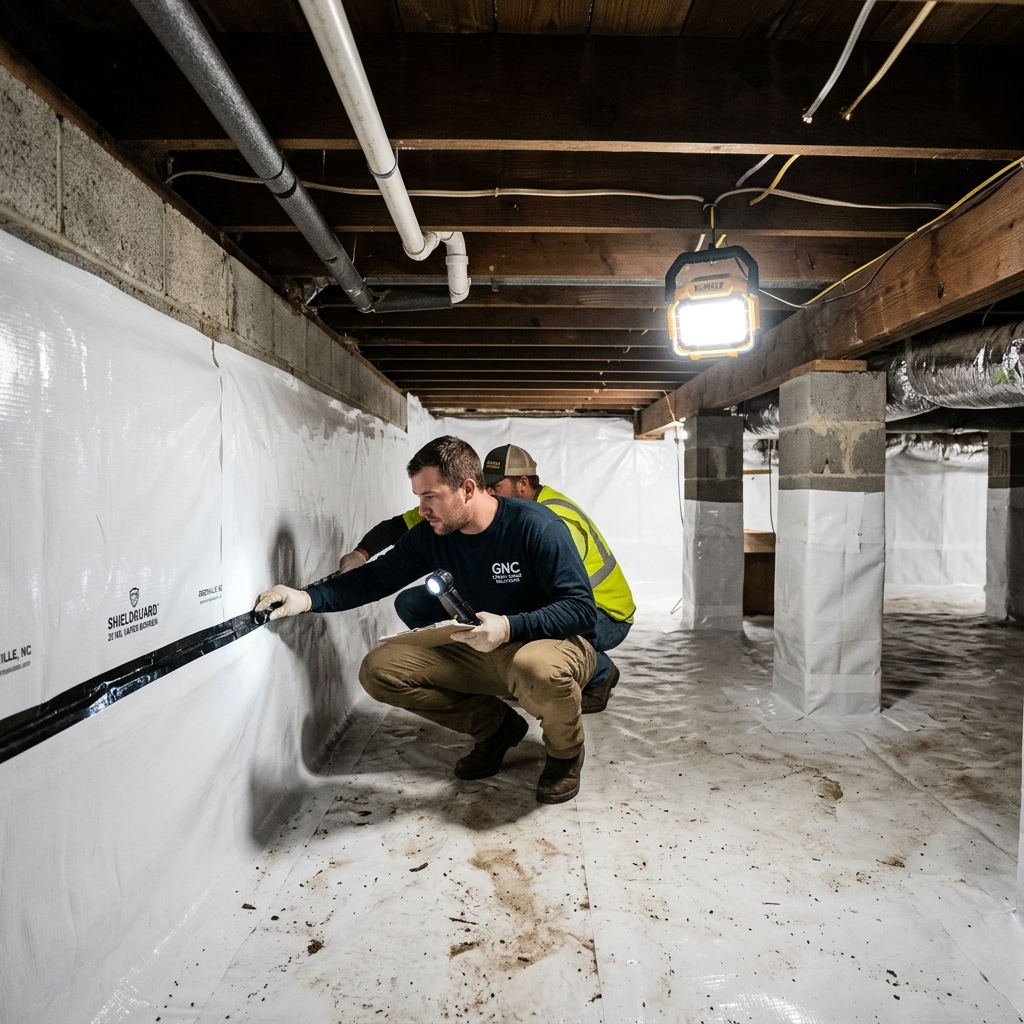
Greenville, NC Crawl Space Projects
Greenville, NC and surrounding Pitt County communities experience high annual humidity and shallow water tables near the Tar River basin. Unsealed crawl spaces in eastern NC frequently collect ground vapor, risking subfloor timber decay.
Illustrative photo of professional building science practices by independent contractors serving Greenville and Pitt County.
Greenville, NC Climate & Crawl Space Characteristics
Pitt County
Sandy Clay Loam with Shallow Water Table
49.5 in/yr Rain
Summer Humidity Avg: 78%. Humid subtropical climate featuring hot summers (averaging 78%+ relative humidity) and frequent tropical storm rainfall events.
Regional Construction
Single-family brick veneer and vinyl-sided homes constructed on continuous concrete block or brick curtain wall foundations.
Water Table Risk
Low-lying areas near the Tar River and local creek drainage basins present elevated risks of seasonal standing water under subfloors.
North Carolina Crawl Space Regional Moisture Map
Click your North Carolina county to explore broad regional context, USDA soil-survey data, NOAA climate normals, and official water and flood-map resources.
Pitt County
Suggested Nearby Service Hub: Greenville, NCThis broad Coastal Plain classification does not establish shallow groundwater, tidal influence, flood exposure, or soil conditions at a property. Parcel elevation, grading, drainage, soil map unit, foundation design, storms, and maintenance all matter.
North Carolina Market Hubs & Regional Directory:
Click card to view context • Click arrow for location pageGreenville & Pitt County Hydrogeology: Soil Mechanics & Moisture Factors
Greenville sits in the Eastern Coastal Plain of North Carolina along the lower Tar River basin. The subterranean soil composition across Pitt County consists primarily of sandy clay loam overlaying shallow water tables. During intense summer thunderstorms, rain runoff saturates upper soil layers. In low-lying areas, moisture wicks upward through porous dirt crawl space floors.
In Pitt County, ambient relative humidity routinely exceeds 78% between June and September. Traditional foundation vents allow hot, humid coastal air to enter cool crawl space environments, resulting in condensation on floor joists and ductwork.
Warm air rising through living spaces pulls replacement air up from the crawl space via the Stack Effect. High subfloor moisture content over extended periods can weaken floor framing and lead to uneven subfloors.
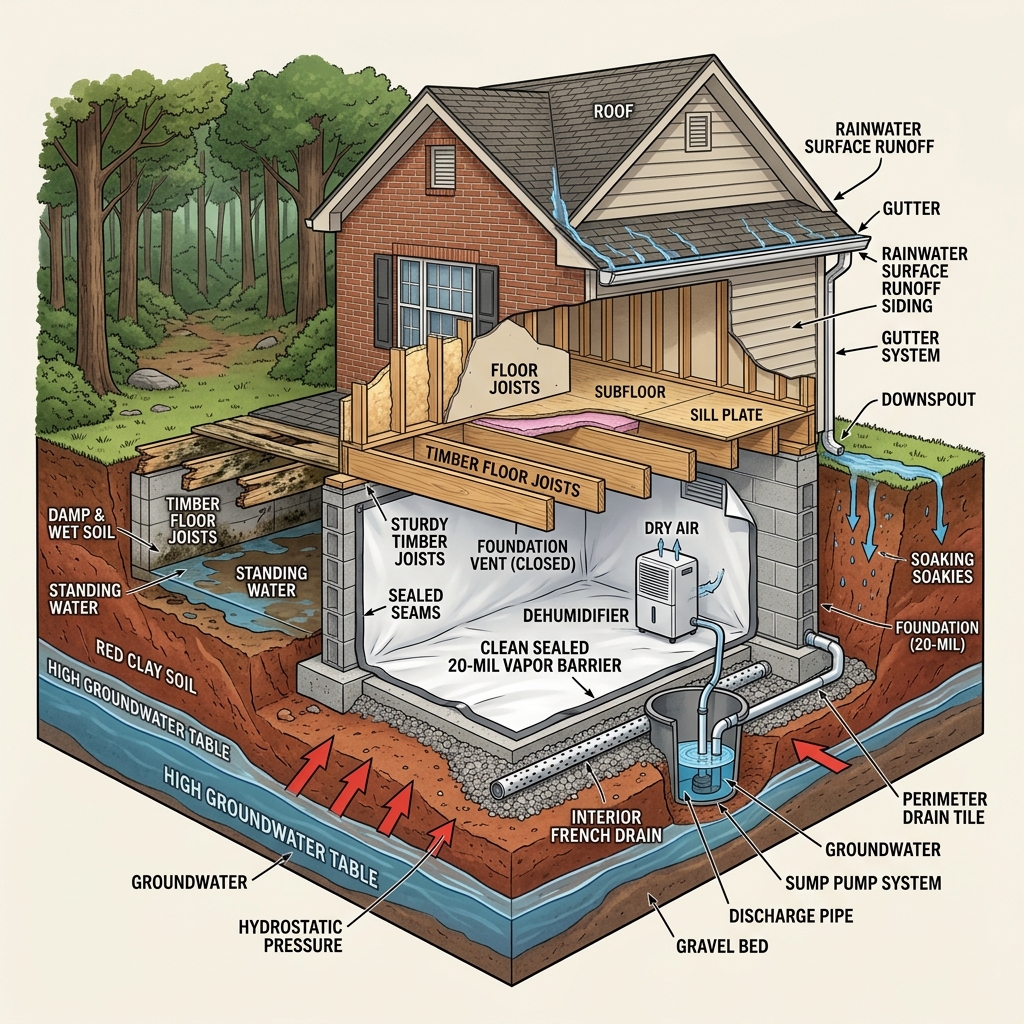
Cutaway illustration of groundwater seepage and 20-mil sealed vapor barrier assemblies in Pitt County clay/sandy soil.
Communities & Neighborhoods Served Near Greenville
Accepting requests from Greenville, Pitt County, and communities throughout North Carolina. (Featured ZIP codes: 27834, 27858, 27833)
Crawl Space Services in Greenville, NC
Crawl Space Encapsulation
Comprehensive sealing of foundation walls, floor ground, and vents with heavy-duty vapor retarders.
Vapor Barrier Installation
Puncture-resistant polyethylene soil liners that reduce ground moisture evaporation.
Crawl Space Mold Treatment
Professional surface mold cleaning, HEPA filtration, and timber preservative applications.
Crawl Space Waterproofing & Drainage
Interior perimeter French drains, water collection basins, and automatic submersible sump pumps.
Crawl Space Dehumidifiers
Commercial-grade self-draining dehumidification units designed for unconditioned crawl spaces.
Floor Joist & Structural Repair
Structural sistering of weakened floor joists, beam replacement, and adjustable jack stabilization.
Greenville, NC Crawl Space FAQs
How much does crawl space encapsulation cost in Greenville, NC?
Crawl space encapsulation in Greenville typically ranges between $4,200 and $9,800 depending on home footprint, access clearance, ground water severity, and drainage requirements. Local contractors provide detailed on-site estimates.
Why do Greenville homes experience heavy crawl space moisture?
Greenville's shallow water table combined with Pitt County's sandy clay loam soil traps groundwater. Summer relative humidity averaging 78% creates heavy condensation when ambient warm air enters cool foundation vents.
Should foundation vents be open or sealed in Pitt County?
Modern building science shows open foundation vents in humid coastal plain climates allow warm, moist air to enter cold crawl spaces, accelerating mold growth. Sealed encapsulation systems manage humidity far more effectively.
Sources & Building Science Methodology
Climate normals, soil water retention metrics, and flood risk characteristics presented for Greenville, NC (Pitt County) are compiled from official public databases. Regional conditions vary by parcel, elevation, grading, drainage, foundation design, and soil map unit.
Regional conditions vary by parcel, elevation, grading, drainage, foundation design, soil map unit, and storm history. This page is not an inspection, engineering analysis, environmental assessment, code determination, or mold diagnosis.
North Carolina climate normals and precipitation data
Real-time surface water and groundwater monitoring in NC
County soil series profiles and moisture retention index
National Flood Insurance Program (NFIP) flood hazard zones
Regional humidity, soil temperature, and severe storm history
Specifications for closed, unvented crawl space foundations
Request an Estimate in Greenville, NC
Get connected with an independent contractor serving your area.